Dr. John Jost, with whom you're familiar if you've read a few of these essays, published some new information together with neuroscientist David Amadio in 2011. Their paper is titled “Political ideology as motivated social cognition: Behavioral and neuroscientific evidence." It's an update concerning Jost's theory about motivated cognition and ideology. It describes new behavioral experiments and neurological evidence for different cognitive processing in conservatives and liberals.
In that paper ideologies are described as socially shared attitude and belief systems. Ideologies offer certainty, security, and solidarity by supporting epistemic, existential, and relationship needs. [Jost 2012, p. 55]
In papers from 2003 and 2007 studies, Jost and his collaborators presented the theory that conservative ideology may be especially attractive to individuals who are permanently or temporarily especially concerned about avoiding threats and managing uncertainty. Those studies resulted in the SEM model (structural equation model) shown in Figure 1. The parameters that go with the arrows have been calculated but aren't shown here because they haven't been standardized. (The numbers may be misleading.)
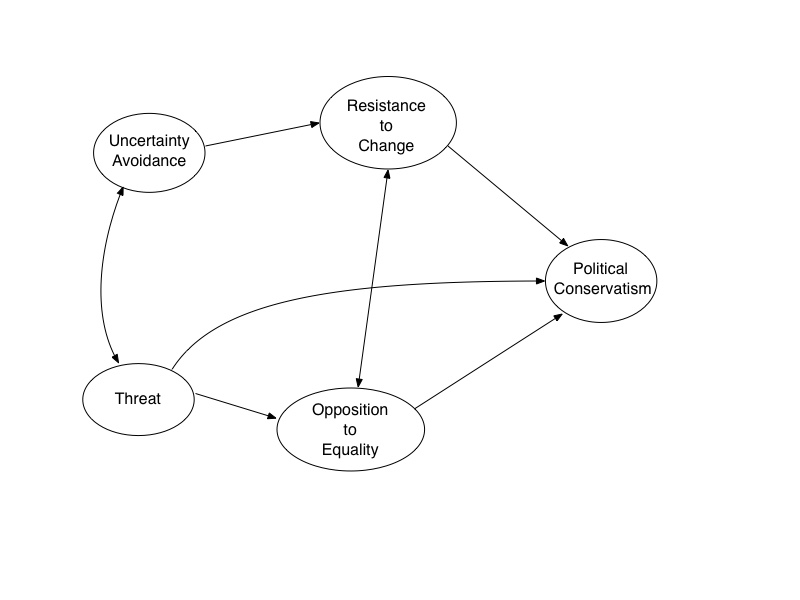
The diagram shows the effects of uncertainty avoidance and threat on conservative political orientation. The effects of threat and uncertainty are moderated or increased by resistance to change (an attribute of right wing authoritarianism or RWA) and opposition to equality (an attribute of social dominance orientation or SDO) respectively. [Jost 2012, p. 57]
A large number of studies during the first decade of the new century have buttressed this model. At least half a dozen independent studies have confirmed that needs for certainty, order, structure, and closure promote conservatism. Several new studies reconfirmed that liberals are more open to (willing to participate in) new experiences than are conservatives.
A lab experiment in which exploration and risk-taking conferred an advantage in a competitive game gave an advantage to political liberals. Surveys showed that an increase in conservatism followed the 9/11/2001 terror attacks. A 2007 study found that right-wing authoritarianism and social dominance orientation both favored insecure interpersonal attachment styles.
Another half dozen studies confirmed the link between conservatism and sensitivity to disgust. In one study, merely asking participants to sanitize their hands caused a measurable increase in conservatism. [Jost 2012, pp. 57-8]
A longitudinal study published in 2006 reported correlations between teachers’ observations of preschoolers at age three and their political affiliations twenty years later. Those who were rated at age three as “fearful, rigid, indecisive, vulnerable and inhibited” tended to conservatism. Those rated as “energetic, resilient, self-reliant, expressive, dominating and more prone to developing close relationships” tended to liberalism.
A longitudinal study of college students found that students who experienced “intergroup threat and anxiety” in their first year of college tended to have high scores in system justification and social dominance (approval of status inequality) in years two and three, and political conservatism at year four.
An additional half dozen lab experiments reported that reminding participants of terrorism and other existential threats increased their positive ratings of conservative political leaders.
David Amadio, a neuroscientist and co-author of the paper under discussion, published results in 2007 of a “Go/NoGo” experiment. Participants in this type of test are trained to respond rapidly to an oft-repeated “W” stimulus, so that response becomes habitual. Occasionally, though, an “M” stimulus is presented. The participant is instructed not to respond at all to “M,” but habituation makes this difficult. [Jost 2012, p. 59]
The study found that participants who self-identified as liberal performed this task more accurately than those who identified as conservative. Performing this task uses a part of the brain called the “anterior cingulate cortex” or ACC. The precise functioning of the ACC isn't yet understood, but it apparently monitors other parts of the brain to detect situations that require additional attention as they arise, and directs attention where it's needed. In this case the ACC monitors conflicts when the habitual response conflicts with the current stimulus.
An electroencephalogram or EEG uses a set of external electrodes to detect the timing and location of strong brain activations. It is able to detect the burst in electrical activity originating from the dorsal ACC that happens about 50 milliseconds after a NoGo error. NoGo errors activated the ACC more strongly among the more liberal participants. This indicates that the errors were more strongly registered by liberals and is presumably related to the greater proficiency of liberals at this task.
The study identified a physiological difference between liberals and conservatives related to decisions under conflict using a task with no obvious political significance. Because of this, it is unlikely that the observed differences could be due to factors such as subjects’ self-presentation or their sense that certain responses might be desirable, which can confuse testing around moral or ideological issues.
(Although this result is consistent with behavioral findings of differing cognitive styles between conservatives and liberals, the specific significance of this result is not clear. The specific functions of the ACC, e.g., are only roughly understood. It is also not known whether the differences observed are causative, caused by, or stand in some other relation to conservative identity.)
An independent study published in 2010 reproduced Amodio’s results, and in addition showed that stronger ACC activation in the Go/NoGo was associated with greater endorsement of egalitarianism and lesser endorsement of authoritarianism.
A 2009 study associated greater religiosity with less ACC activation. This study used a different subject task, a Stroop test. (In a Stroop task, subjects are presented an incongruent stimulus, such as the word “green” written with a red font. This causes measurable delays in responding.) The significance of this discovery is unclear.
A 2008 study looked at physiological measures of fear in relation to political attitudes. Subjects’ political orientation was assessed in this study by asking their attitudes about military spending, capital punishment, school prayer, gay marriage, gun control, and abortion rights. (These attitudes may reflect SDO rather than RWA. See Two Types of Conservatism: Conformity and Dominance.) [Jost 2012, p. 60]
In one experiment, subjects were shown pictures of spiders, bloody faces, and rotten food, during which their skin conductance responses (SCR) were measured. SCR measures the activity of sweat glands, which increases under threat. Subjects who held right-wing views had stronger SCRs to these threatening images than did those with left-wing views. Responses to non-threatening images didn’t differ based on political attitudes.
In a second experiment, subjects’ eye-blink responses to a sudden, startling burst of white noise were measured. Again, those with right-wing beliefs had stronger reactions. Known neural circuits are activated in the startle response, importantly including the amygdala. These findings don’t establish any causative links either from the amygdala to conservatism nor in the other direction. Much is yet to be understood.
That said, a 2011 study reported on findings that physical differences in the volume of some brain regions exist between liberals and conservatives. Among ninety British undergrads, liberalism corresponded with larger ACC volume, while conservatism corresponded with larger volume of the right amygdala. This was so after adjustment for age and gender among the subjects, and it was so with a second set of twenty-eight subjects. This seems to support a link between political ideology and the processing of threat, but our knowledge of brain function is rather too coarse-grained at the present to support a high level of confidence. Nevertheless, survey evidence, behavioral evidence, and neuroscientific evidence now exist to support that conclusion.
Next: Automatic Conservatism
More information:
[Jost 2012] “Political ideology as motivated social cognition: Behavioral and neuroscientific evidence,” Jost, John T., and Amodio, David M., “Motivation and Emotion,” Springer Science & Business Media, Vol. 36, 2012.
© 2021, Ross A. Hangartner