Important: This essay is about conservatives on the dishing-out end of disgust.
Disgust is one of the six emotions that are considered basic in humans by affective neuroscientists. Gordon Hodson and Kimberly Costello reported on the linkages among disgust, conservatism, and dehumanization in 2007 in a paper titled "Interpersonal Disgust, Ideological Orientations, and Dehumanization as Predictors of Intergroup Attitudes." Dehumanization is a psychological distancing process that operates by denying the human characteristics of others.
Interpersonal disgust, disgust toward other humans, is hypothesized to be a motivating factor in both RWA (right wing authoritarianism) and SDO (social dominance orientation), and through these for dehumanization of out-groups and related invidious stereotyping.
Disgust is an emotion that motivates avoidance. It is believed that disgust evolved to assure avoidance of unhealthy things, such as things that are unsafe to eat or touch. It is certainly an ancient emotion that appears to exist in birds and other mammals, so it involves deep layers of the brain.
There may be an evolved tendency to feel disgust toward outsiders, that is, people who you are not accustomed to. If so, this could be a behavioral safeguard to avoid contagion. Disgust reactions are known to occur toward some ill or disabled people. These reactions have been likened to an over-generalized avoidance of disease. Disgust is a plastic emotion, and has been felt toward cultural practices and culturally-deviant behavior such as homosexuality. Concerns about contamination and purity are related to disgust. [Hodson 2007, p. 691]
Basic disgust reactions can be studied in animal models in great detail and using destructive techniques. Our knowledge of disgust in humans is largely based on inferences from these animal models. Our knowledge of distinctively human phenomena such as disgust toward outgroups, physical deviants, and behavioral deviants is much more deductive and speculative. In particular, it isn't known just how plastic disgust is, nor how controllable disgust is.
Disgust establishes a better/worse vertical or hierarchical dimension when applied to other humans. It increases the importance of group boundaries, whether disgust is based on fear of biological contagion or fear of social defilement. Because of its vertical dimension, disgust toward others can promote a sense of the hierarchical superiority of the in-group. This sense of superiority can then motivate a rationalization for discriminatory treatment of out-groups. Among RWAs aggression toward out-groups tends to accompany fear and disdain toward others. Among SDOs a sense of superiority legitimizes discrimination. Disgust makes exposure and habituation to others less likely, perpetuating the conditions that support it.
In her recent book "Caste," Isabel Wilkerson shares an analysis and personal testimonial about American racism. Wilkerson is struck with the parallels between modern American race-based discrimination and the caste-based discrimination of modern India. She makes a forceful and convincing argument for the tenacity and persistence of both these systems.
Wilkerson sees the two systems as structurally analogous and identifies what she believes to be the "pillars" of the systems. Her fourth pillar is built on purity and pollution, derivatives of the disgust emotion:
[T]he fourth pillar of caste rests upon the fundamental belief in the purity of the dominant caste and the fear of pollution from the castes deemed beneath it. [Wilkerson 2020, p. 115]
Hence disgust serves as a motivator or a pretence for discrimination, school segregation, and other such curses on the white race.
The Hodson and Costello study was an effort to flesh out our knowledge of the political effects of disgust. One hundred-three English Canadian undergrads at Brock University in Ontario, about three-quarters female, participated in this study. The researchers collected data on feelings of these students toward distinct categories of others.
Each subject completed “feeling thermometers” to indicate their feelings about:
Each subject completed a 32-item Disgust Scale to register his or her own sensitivity to several types of disgust:
Each subject also completed a Perceived Vulnerability to Disease (PVD) instrument, which measures the extent to which the subject feels vulnerable to contagion; and a measure of dehumanization regarding each of the out-groups. The degree of "dehumanization" toward each out-group was the degree to which members of the out-group were perceived to fail to experience “human” emotions. [Hodson 2007, p. 693]
The researchers were thus able to see the feelings of subjects toward each of several categories of out-groups; the subjects' sense of the "humanity" of the several out-groups; the subjects' own sense of vulnerability to disease; the subjects' own sense of sensitivity to four flavors of disgust.
The results showed that high sensitivity to interpersonal disgust was significantly associated with negative attitudes towards immigrants (r = -.25) and with negative attitudes towards ethnic foreigners (r = -.29). High sensitivity to interpersonal disgust was only weakly associated with negative attitudes toward deviant and low-status groups. No relation at all was found between high sensitivity to interpersonal disgust and attitudes toward familiar out-groups. On the other hand, higher interpersonal disgust sensitivity was associated with more-positive feelings toward other in-group (English Canadian) members (r = .27). Other types of disgust sensitivity didn’t contribute to these relations.
Perceived vulnerability to disease (PVD) was highly correlated with high sensitivity to interpersonal disgust (r = .57). Sensitivity to interpersonal disgust explained negative feeling towards out-groups better than did PVD. Sensitivity to interpersonal disgust was also strongly correlated with both RWA (r = .54) and SDO (r = .36). Again, PVD didn’t add explanatory strength.
Results also showed that high sensitivity to interpersonal disgust was highly correlated with dehumanizing attitudes toward ethnic foreigners (r = -.35), toward deviant and low-status groups (r = -.27), and toward immigrants (r = -.31).
All of these correlations were highly statistically significant [Hodson 2007, p. 694]
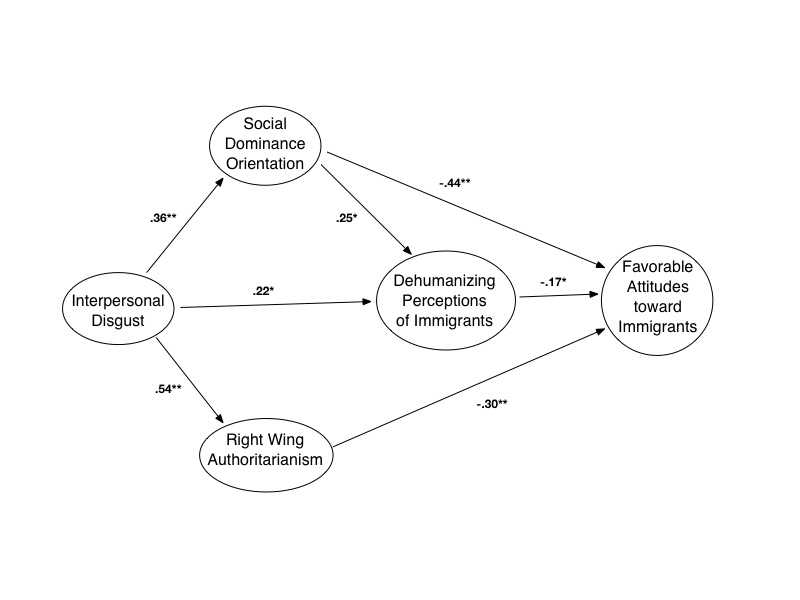
Figure 1 shows the SEM or path diagram for the study results. (See A Causal Chain for Conservatism? for an explanation of SEM and path diagrams.) The path analysis of these results shows that high levels of either Right Wing Authoritarianism or Social Dominance Orientation enhance the effect of interpersonal disgust sensitivity on dehumanizing attitudes and unfavorable attitudes toward immigrants. This is consistent with the idea that RWA and/or SDO offer a cognitive assist in maintaining these anti-out-group attitudes. (The experiment doesn’t reveal whether sensations of disgust directly increase RWA and SDO beliefs or whether existing RWA or SDO attitudes simply potentiate or allow the sensation to manifest in anti-out-group outcomes.)
Next: The Heritability of Ideology
More information:
[Wilkerson 2020] “Caste,” Isabel Wilkerson, Random House, 2020.
[Hodson 2007] "Interpersonal Disgust, Ideological Orientations, and Dehumanization as Predictors of Intergroup Attitudes," Hodson, G., and Costello, K., “Psychological Science,” Vol. 18, No. 8, 2007.
© 2021, Ross A. Hangartner