John Duckitt is another social psychologist who has long been involved in explanatory theories of conservatism, integrating conservatism with other social-psych theory. He published “A Dual-process Cognitive-motivational Theory of Ideology and Prejudice” in 2005. This paper presents arguments that RWA and SDO represent two basic dimensions of life strategy; that motivated cognition tends to guide us into a suitable place in a field of strategic options; and that the data support a chain of causation leading from socialization through RWA/SDO through to expression of tolerance or intolerance.
The data show that RWA and SDO together account for about half of the variability in intergroup stereotyping and ethnocentrism. This leaves quite a bit to be explained, but identifies them as major drivers.
On the other hand, RWA and SDO aren’t highly correlated with one another and seem to be separate sets of attitudes. There is evidence, however, that these two become more correlated as a person ages. It is a reasonable conjecture that this is because, on the left-right political spectrum that exists in the U.S. and other Western countries, RWA and SDO views are “packaged” together in the programs of the political parties. Liberals tend to be low-RWA and low-SDO, conservatives higher in one or both. The increasing alignment of RWA and SDO with age may be the result of a social learning process or of individuals reducing dissonance. [Duckitt 2001, p. 44]
While RWA and SDO are each distinct from other measures, Duckitt tabulated a large list of concepts that closely resemble RWA. These have been proposed by investigators in several different fields over several decades.
| RWA-like studies | Hi RWA | Lo RWA |
|---|---|---|
| Hughes | Conservatism | Liberalism |
| Middendorp | Cultural Conservatism | Openness |
| Katz & Hass | Hi Protestant Ethic | Lo Protestant Ethic |
| Forsyth | Lo Relativism | Hi Relativism |
| Eysenck | Conservatism | Liberalism |
| Kerlinger | Hi Protestant Ethic/Traditionalism | Lo Protestant Ethic/Liberalism |
| Tomkins | Hi Normativism | Lo Normativism |
| Rokeach | Lo Freedom | Hi Freedom |
| Braithwaite | Hi National Strength and Order | Lo National Strength and Order |
| Saucier | Hi Conservatism/Authoritarianism | Lo Conservatism/Authoritarianism |
| Schwartz | Conservatism | Openness |
| Hofstedt | Collectivism | Individualism |
| Triandis and Gelfand | Collectivism | Individualism |
| Trompanaars | Group Loyalty | Individualism |
He also identified concepts paralleling SDO:
| SDO-like studies | Hi SDO | Lo SDO |
|---|---|---|
| Hughes | Economic Conservatism | Social Welfare |
| Middendorp | Economic Conservatism | Equality |
| Katz & Hass | Lo Humanitarianism/Egalitarianism | Hi Humanitarianism/Egalitarianism |
| Forsyth | Lo Idealism | Hi Idealism |
| Eysenck | Tough | Tender |
| Kerlinger | Lo Liberalism | Hi Liberalism |
| Tomkins | Lo Humanism | Hi Humanism |
| Rokeach | Lo Equality | Hi Equality |
| Braithwaite | Lo International Harmony and Equality | Hi International Harmony and Equality |
| Saucier | Lo SDO and Machiavellianism | Hi SDO and Machiavellianism |
| Schwartz | Power | Egalitarianism |
| Hofstedt | Hi Power Distance | Lo Power Distance |
| Triandis & Gelfand | Vertical Values | Horizontal Values |
| Trompanaars | Hierarchy | Egalitarianism |
These findings are based on data from a number of mostly Western nations. Duckitt proposes that these dimensions are basic because each defines two fundamentally incompatible social strategies. [Duckitt 2001, p. 50]
The dimension measured by RWA indicates, at its high-RWA pole, a strategy that commits to life as a member of a group. Group membership carries a number of benefits, including of course companionship, identity as a group member, shared group status, and, in situations of threat (including resource competition), economic, political, and cultural security. The group-centered strategy also entails costs.
At the low-RWA pole of this dimension, an individualist strategy is less dependent upon and less constrained by the demands of group membership. The group is less dominant in the individual’s life, so the individual has more space. The two strategies, which can be thought of as opposite ends of a continuum, have different benefits and different costs.
The second major dimension, described and measured by SDO, centers on one’s relation to others in obtaining status and other desirable things. At its high-SDO pole, the strategy involves self-acknowledged and unconstrained (although possibly concealed) competition. At the low-SDO pole of this dimension, the strategy involves cooperation and mutual support.
The “dual-process” part of the paper’s title refers to these two dimensions. The researchers posit that in general one chooses a position on each dimension. It’s difficult to be strongly invested in group membership and simultaneously act independently of the demands of the group, at least in part because group membership normally requires members to adhere to norms of behavior. (This doesn’t imply that membership is burdensome to the member.) In the same way, it’s difficult to be highly exploitative and at the same time convincingly supportive.
The two ends of the two dimensions would represent four distinct life strategies. All four of these strategies are supported by schemas or world views that exist socially within the culture. These schemas include “legitimizing myths” which support the strategy, as well as norms relevant to the strategy. (The term “myth” here is not meant to imply lack of verity or traditional origins. I prefer the term “legitimizing narrative.”) Formal and informal groups exist which nurture and support each of the strategies.
The schemas act as filters which affect what is experienced and how that is interpreted. The schemas are taught, modeled, and sometimes enforced, which ensures that they can be kept highly accessible. This is what we call “ideology.” Thus, ideology has the role of facilitating and reinforcing these life strategies. The schemas are not simple, and include demonstrations, consequences, and heuristics for dealing with the facts, as they are recognized within the schema.
Legitimizing schemas include at their core beliefs about the nature of the world that enable and legitimize their corresponding strategies. [Duckitt 2001, p. 50] A social worldview is a “coherent system of beliefs about the nature of the social world, specifically, about what people are like, how they are likely to behave to one[self], and how they should be responded to and treated.” [Duckitt 2001, p. 69] A dangerous/threatening social worldview includes the “belief that the social world is a dangerous and threatening place in which good, decent people’s values and way of life are threatened by bad people” as opposed to the “belief that the social world is a safe, secure and stable place in which almost all people are fundamentally good.”
| Hi RWA | Lo RWA |
| The Social World is Dangerous (“The world is a dangerous place.”) | The Social World is Secure |
| Hi SDO | Lo SDO |
| Competition is Inevitable and/or Desirable (“The world is a competitive jungle.”) | Competition is Not Inevitable and may not be Desirable |
Researchers on personality, authoritarianism, and group stereotyping have long hypothesized that differences in child socialization may have life-long effects on personality, which in turn would have long-term effects on the attractiveness of different social world views. A chain of relationships thus has been hypothesized from socialization through to ideological perspective. In this hypothesis, the manner of socialization favors (tends to encourage) certain personality traits, which in turn favor the adoption of certain world views. These world views, in turn, make certain motivational goals and their attendant strategies more likely, resulting in what we observe as an ideology. [Duckitt 2001, p. 52]
| Hi RWA | Lo RWA | |
|---|---|---|
| Socialization | Punitive | Tolerant |
| Favored Personality | Conforming | Autonomous |
| World View | Threatening/Dangerous | Safe/Secure |
| Motivational Goal | Group Security/Social Control | Autonomy/Personal Freedom |
| Political Ideology | Authoritarian/Conservative | Liberal/Autonomous |
| Hi SDO | Lo SDO | |
|---|---|---|
| Socialization | Unaffectionate | Affectionate |
| Favored Personality | Tough | Tender |
| World View | Competitive Jungle | Cooperative Harmony |
| Motivational Goal | Dominance | Altruism |
| Political Ideology | Social Dominance | Egalitarianism |
Duckitt et al., based on those prior findings, developed a model of the relationships among these factors that could be tested with survey data, and developed a survey instrument (questionnaire) to collect measurements of the various factors. The diagram is known as an SEM (structural equation model) diagram, or more generically as a path diagram. This particular diagram shows only the factors that enter into the hypothesis above. The questionnaire scores that define the values of the factors aren't shown on the diagram. [Duckitt 2001, p. 58]
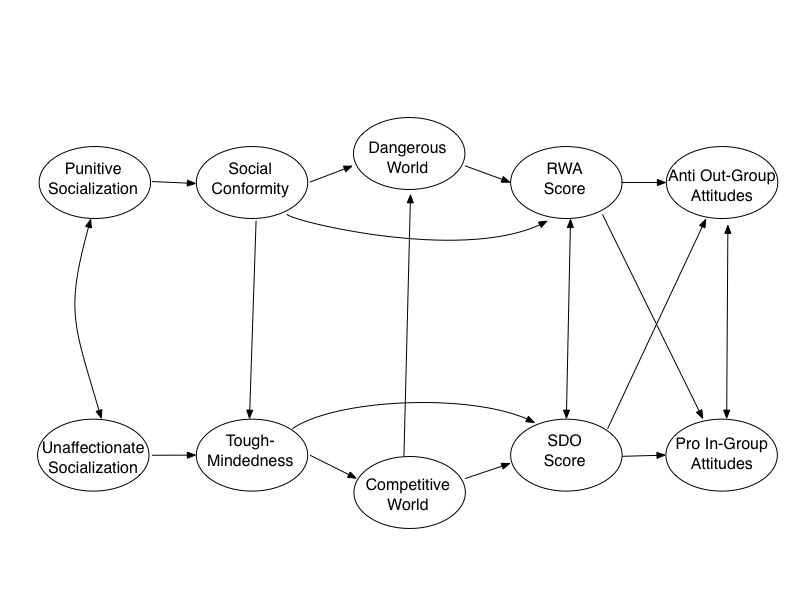
Each arrow in the diagram indicates that the value of the factor at one end of the arrow affects the value of the factor at the other end. Most of the arrows are directed from one factor (at the tail of the arrow) to another (at the head of the arrow). This implies that the first factor “causes” the second factor to change. However, the statistical analysis which will test the model can’t prove causality, only correlation. Causality must be demonstrated via other evidence. The authors of the model have argued that causality here makes sense, given their understanding of the underlying processes. More about that later.
This model from left to right links socialization to personality traits, to worldviews that are facilitated by personality, then to RWA and SDO ideologies (authoritarianism and dominance orientation) promoted by the worldviews, then from ideology to attitudes toward the in-group and the out-group.
The model hypothesizes that “punitive socialization,” with its presumed emphasis on following rules, would tend to increase “social conformity,” a personality trait. “Unaffectionate socialization,” because it lacks affection, would increase the personality trait of “tough-mindedness.” The two-headed arrow indicates that punitive socialization is expected to influence unaffectionate socialization and vice versa, that one will tend to accompany the other.
The personality trait of social conformity was expected to influence both belief in a dangerous world and RWA score. In addition, social conformity was expected to influence RWA indirectly through its effect on belief in a dangerous world and the dangerous world belief’s effect on RWA.
Similarly, tough-mindedness would affect SDO directly, and indirectly through its effect on the belief that the world is a competitive jungle.
Belief in the world as a competitive jungle was expected to influence belief in a dangerous world, but the reverse effect wasn’t expected.
Finally, both RWA and SDO were expected, in agreement with many previous studies, to affect attitudes toward the in-group (the subject’s own group) and toward the out-group (or out-groups).
The concepts used in the model aren’t just labels. They are measurements calculated from subjects’ answers to designed measurement scales. The questions used to measure the various scales used in this model follow. Understanding the scales is important to understanding the results:
| Kind | Compassionate | Ruthless | Cynical |
| Tough-minded | Tender-minded | Forgiving | Hard |
| Caring | Giving | Merciless | Gentle |
| Hard-hearted | Unfeeling | Soft-hearted | Brutal |
| Humane | Sympathetic | Uncaring | Harsh |
| Rebellious | Unorthodox | Conforming | Conventional |
| Old-fashioned | Free-living | Non-conforming | Moralistic |
| Obedient | Unconventional | Unpredictable | Erratic |
| Respectful | Predictable | Experimenting | Innovative |
| Individualistic | Respectable | Law-abiding | Compliant |
The statistical methods used to test this complex model are also called “structural equation modeling,” or SEM. SEM is related to but more complex than multiple linear regression. It is able to validate or reject the proposed model, to estimate the strength of the relationships, and report on their statistical significance. It can’t, however, prove that the factors on the left cause the factors to their right, only that they are correlated.
Duckitt et al. tested their hypotheses against three sets of data, collected from undergraduates in New Zealand and South Africa. As they collected and analyzed results, they modified their model and questionnaires to reflect their learning. I show, therefore, the model resulting from the final South African study. This shows results which are believed in part to be specific to conditions around 1999 in South Africa, which particularly affect in-group and out-group attitudes.
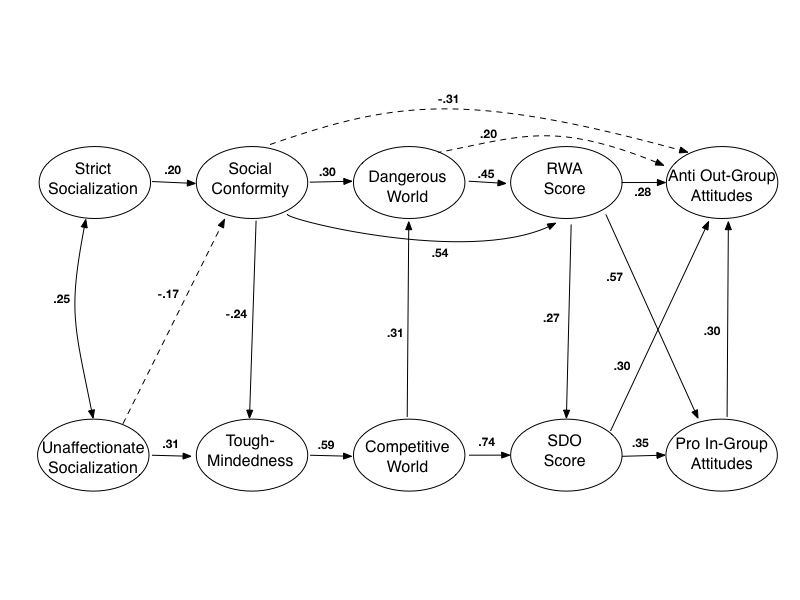
The values along the arrows are the calculated correlations between two connected factors. These correlations range in value from -1 to +1. A value of +1 would mean that the two items are perfectly correlated, that is, the value of the factor at the head of the arrow is completely determined by the value of the factor at the tail. A value of -1 would again mean that the two items are perfectly correlated, but in this case, when the value of one factor goes up, the value of the other factor goes down. A value of 0 means that there is no relation between the values of the two factors or, more precisely, that there is not sufficient statistical evidence to conclude that they are related.
A correlation value of 0.30 means roughly that a change in the value of the first factor means 30% as much change in the second factor. A correlation of -0.20 means that a change in the first value results in 20% as much change in the second factor, but in the opposite direction. (When the first value goes up, the second goes down, and vice versa.)
When correlation arrows lead from a first factor to a second factor, and then to a third factor, the correlation between the first and third factors is found by multiplying together the two intervening correlations. If factor A has a correlation of 0.5 with factor B, and factor B has a correlation of 0.5 with factor C, then factor A has a correlation of 0.5 * 0.5 = 0.25 with factor C. (This assumes that there is only this one path from A to C.)
When two factors are linked by two or more chains of arrows, the correlation between the two is found by calculating the correlation contributed by each chain, then adding those correlations. Referring to Figure 3, there are two paths between SDO Score and Anti Out-Group Attitudes. The first path goes directly to Anti Out-Group Attitudes. The correlation contributed by this path is .30. The second path goes from SDO score through Pro In-Group Attitudes to Anti Out-Group Attitudes. The correlation contributed by this chain is .35 * .30, or .105. To find the total correlation between SDO Score and Anti Out-Group Attitudes, add .35 to .105. The result is .455. (See Wikipedia at “Path analysis (statistics)” for an explanation of how to compute multi-path correlations.)
Duckitt et al. began with the hypothesized model shown above in Figure 1, and ended with the model shown in Figures 2 and 3. Besides adding the correlations to the diagrams, the researchers changed the Punitive Socialization factor to Strict Socialization. They made this change when their first test of the Figure 1 model showed that Punitive Socialization likely reflected more than one factor, one of which is Strict Socialization.
The dashed arrows in Figures 2 and 3 are another addition. The researchers didn’t predict those connections, but the statistical analysis showed that they exist. Such is scientific progress.
So, what did the researchers find out? There is a lot of information in the completed diagram, so here are some of the big items.
The research team had first hypothesized that punitive socialization and unaffectionate socialization would affect, respectively, social conformity and tough-mindedness. Results in intermediate studies showed that punitive socialization intermingles two factors, so the final model replaces punitive socialization with one of those factors, strict socialization.
The analyses showed that unaffectionate socialization tends to decrease social conformity. This result was found not only in the pictured South African results, but also in results from two studies conducted in New Zealand. Unaffectionate socialization has moderate-to-strong effects on tough-mindedness [Duckitt 2001, p. 84]
The expanded model shown in Figure 3 explains over sixty percent of the variability in SDO and RWA, and nearly sixty percent of the variability in Pro In-group and Anti Out-group attitudes. This is a substantial increase from the fifty percent that is explained by just SDO and RWA.
In the New Zealand studies, RWA and SDO affected each other reciprocally. Higher RWA implied higher SDO, and vice versa. In the South African study, the influence flows only from RWA to SDO. The researchers attribute this to the unique history of South Africa that created the situation there in 1999 when this study was conducted. The in-group here is the White Afrikaners. They are and have been a minority, and have been opposed by both Black Africans and the English government for various reasons in different historic periods. The researches interpret this feature of the model to reflect the pressing need for cooperation within the Afrikaans group, which cultivated high levels of RWA.
These diagrams can give a misleading impression. They do not show the entire system of factors and influences. They shouldn’t be read as if some attitudinal substance flows from the left as inputs to the right to create attitudinal outputs. The arrows represent correlations, and the values indicate the magnitude of the correlations. Although we can talk about these as being “causal” models, the statistical analysis shows only that the observed numbers could have come from the system pictured if the relations were causal.
The researchers, however, see the model as causal in a qualified way:
The utility of a model such as this can be suggested by looking at the bubble for Social Conformity. An arrow bearing the value -.31 extends from Social Conformity to Anti Out-group Attitudes. (Its dotted tail indicates that this relationship wasn’t proposed by the modelers, but was discovered by the software.) The negative value means that someone with high social conformity was likely to express lower anti out-group attitudes (less prejudice).
This might be unexpected, since that same conforming someone is likely to belong to groups with high SDO or RWA leanings, and therefore permissive attitudes about intergroup prejudice. On the other hand, strong norms against expressing such sentiments exist in New Zealand and more recently in South Africa. In one of the two New Zealand studies this parameter was positive, that is, social conformity accompanied greater anti out-group expressions. These conflicting results can be resolved, conjecturally, by the known fact that politically correct norms can be applied or ignored situationally.
This theory and model suggest a basic model of the motivations for political ideologies.
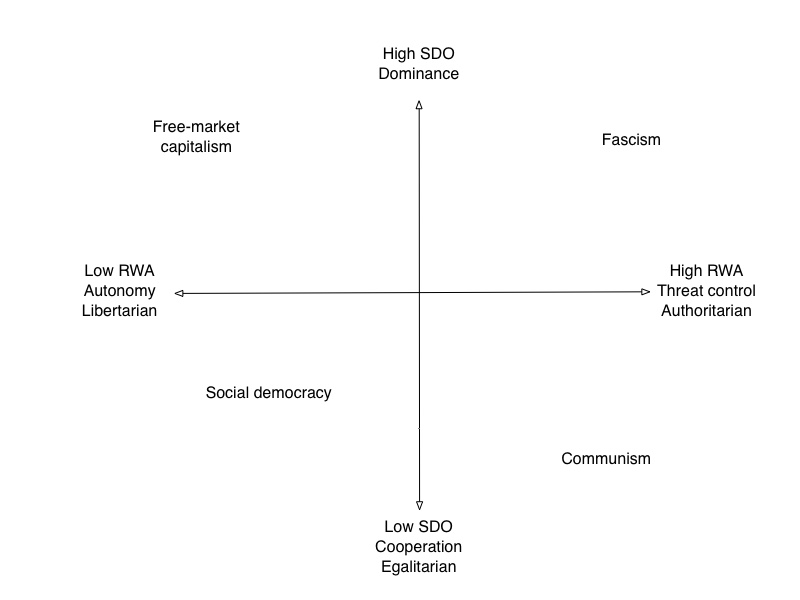
Fascism is the coexistence of high SDO (desire for social dominance) with high RWA (authoritarian submission and enforcement). Communism would be the combination of low SDO (egalitarianism) with high RWA. (I’m not sure whether this may be some utopian communism rather than communism as it has existed.) “Free-market” capitalism would be a combination of high (or at least moderately-high) SDO with low RWA. Social democracy might be a good name for the combination of low SDO with low RWA. Free-market capitalists would dispute this, based upon a conception of freedom that is consistent with large status inequalities. See Free and Fair Markets.
This model throws some light on the contested question of the influence of personality on racism (and presumably other forms of tolerance), and the established knowledge that political orientation is heritable. Personality appears toward the left side of the model in the form of social conformity or tough-mindedness. Personality works upon social worldview and ideology to affect tolerance. This provides an answer to Adorno’s quest for the authoritarian personality: social worldview and political ideology stand between personality and intolerance. [Duckitt 2001, p. 90]
The model also indicates the central role of social worldview in facilitating or discouraging intolerance. While worldview is affected by personality it is also affected by social experience. If the world in which the subject lives is dangerous, it will encourage belief in a dangerous world. Authoritarian groups with strong normative requirements and clear membership boundaries are dangerous and contingent (because membership is at risk), reinforcing the authoritarianism of group members. If the subject’s world is highly-competitive, winner-take-all, it will encourage his belief that the world is a competitive jungle. Highly competitive groups (such as business organizations) thus reinforce the dominance orientation of their own members.
It is a notion accepted by many social scientists, including anthropologists and organization theorists, that the environment is a major factor in determining ideology. There must be a degree of fit between productive technology and social organization, for example, and ideology must be compatible with social organization. When social environments change it is to be expected that social worldviews will change. This has been demonstrated both by experiment and through natural changes such as World War I, the Great Depression, and the Industrial Revolution. Such changes must exert great stress on those affected, and particularly those enmeshed in authoritarian groups. As the environment changes, such groups must typically attempt to maintain norms that may no longer match either the worldviews or the practical needs of its members. It is possible that even small and gradual changes could cause disproportionate stresses within groups and within members.
Its [slavery’s] foundations are laid, its cornerstone rests upon the great truth that the negro is not equal to the white man; subordination to the superior race is his natural and moral condition.
Alexander Stephens, soon to become vice president of the new confederacy, upon returning from Alabama’s secession convention in 1861. Quoted in Armstead Robinson, “Bitter Fruits of Bondage,” University of Virginia Press, 2005, p. 41.
The model and theory also suggest that there should be two different forms of intolerance toward out-groups, which these authors call “prejudice” or “racism.” One form of intergroup intolerance would be associated with high RWA, motivated by threat, and would focus on the threat posed by the out-group. Out-groups would be seen as dangerous to “social or group cohesion, security, order, values, and stability.” [Duckitt 2001, p. 84]
Another form of intergroup intolerance would be associated with high SDO, motivated by a desire to dominate, and would focus on the inadequacy or lack of deservingness of the out-group. Out-group members would be seen as “inferior, weak, inadequate and failures.” [Duckitt 2001, p. 84]
Each of these forms of intolerance would be expected to motivate the partitioning of the worlds into “us” and “them.” Drum roll....
And much evidence of this has been found by researchers into racism. The following table shows the major features of these two forms.
| Motivation | Control of threat | Competitive dominance |
|---|---|---|
| Metric | RWA | SDO |
| Social categories used | Good and decent vs. bad and deviant | Superior vs. inferior |
| Stereotype dimension | Beneficence traits | Competence traits |
| Attitudinal dimension | Disliking vs. liking | Disrespect vs. respect |
| Affective dimension | Negative: anger, fear, anxiety | Low positive affect: disdain |
| Type of racism | Aversive/symbolic/“hot”racism | Dominating/traditional/“cold” racism |
Susan Fiske has reported research that aligns with this view, which is the principal theme of her book “Envy Up, Scorn Down.” [Fiske 2012] Other researchers have distinguished modern or symbolic racism from traditional or old-fashioned racism. Symbolic or modern racism blends “anti-Black affect with conservative ideological beliefs and the feeling that Blacks threaten and violate traditional American values such as individual responsibility and self-reliance, the Protestant work ethic, obedience and discipline. Traditional racism, on the other hand, has been seen as consisting primarily of beliefs in Black inferiority, White supremacy, and support for racial segregation.” [Duckitt 2001, p. 86] Additional discussion of these ideas about racism can be found in [Duckitt 2001, p. 84 et cf.].
Several theories have been developed which seem to deal with RWA-style, threat-conscious forms of racism. Realistic Conflict theory deals with reaction to “real” threats to status and other resources. Contact theory concerns threatening or unpleasant contacts and contacts with out-group members that demonstrate competing goals and interests. Terror Management theory deals with threats to basic sociocultural values and beliefs. Social Identity theory considers threats to social identity (largely status) posed by out-groups.
Other racism theories seem to deal with SDO-style competitive dominance. The threats to social status dealt with by Social Identity theory are a psychological and political concern to “competitive jungle” advocates. Contact theory has identified the fundamental role of status and power inequalities in facilitating out-group prejudice. Circumstances that threaten the dominance of groups are likely to promote intolerance toward out-groups, whether it is motivated by fear or by an ambition to dominate. [Duckitt 2001, p. 97] This was predicted by Duckitt and his collaborators in 2001. It’s been confirmed in our history from 2009 forward.
Duckitt et al. made two predictions from their studies:
So, there you have it, Donald Trump, Steve Bannon, and Stephen Miller in a sociological nutshell, their weakness and anxiety exposed, fourteen years before Trump invited himself into the discussion. Prediction 1 explains news as a public enemy, liberals as arrogant and usurping, Black Lives Don’t Matter, “Great Again,” and the celebration of "white" symphonies that none of them listen to. Prediction 2 covers anger with Blacks, Jews, Asians, and liberals. It may also explain the Black guy who goes to Trump's rallies. West Virginia Senator Joe Manchin, who is reluctant to use his vote against today’s conservative crusade, may be having trouble seeing himself on the painful end of hysterical intolerance, as a target of fear and loathing. (Or perhaps he sees it very clearly.)
This same model would predict that both high-RWA and high-SDO groups would be traumatized by clear evidence that they no longer are the dominant group. What are the limits which would constrain their reaction to such news? On p. 100 Duckitt explains the current situation of the Republican party: a minority, strongly cohesive, feeling strongly threatened by the majority, and feeling strongly that in some way they are entitled to control.
Duckitt went on to use these propositions to explain how and why high RWA and high SDO members of out-groups may affiliate ideologically with the high RWA and SDO groups, so he didn’t precisely predict Steve Bannon and the pathetic fate of the GOP. But this is still quite a remarkable illustration of the power of science in an area so complex and murky. And, speaking to Duckitt’s point, if this dynamic explains minority-group members who support the Trump program, their presence at his rallies doesn’t imply that they believe his program isn’t intolerant and chauvinist. It only implies that they have personal motivations that override this.
Next: A Dynamic Picture of Authoritarianism
More information:
[Duckitt 2001] “A Dual-process Cognitive-motivational Theory of Ideology and Prejudice,” John Duckitt, 2001, “Advances in Experimental Social Psychology,” Vol. 33, 2001.
© 2021, Ross A. Hangartner